Compare
Statamic vs Payload
Two excellent CMS platforms. One big decision — what’s your preferred ecosystem?
Spoiler alert: neither is objectively “better.” We know, controversial.
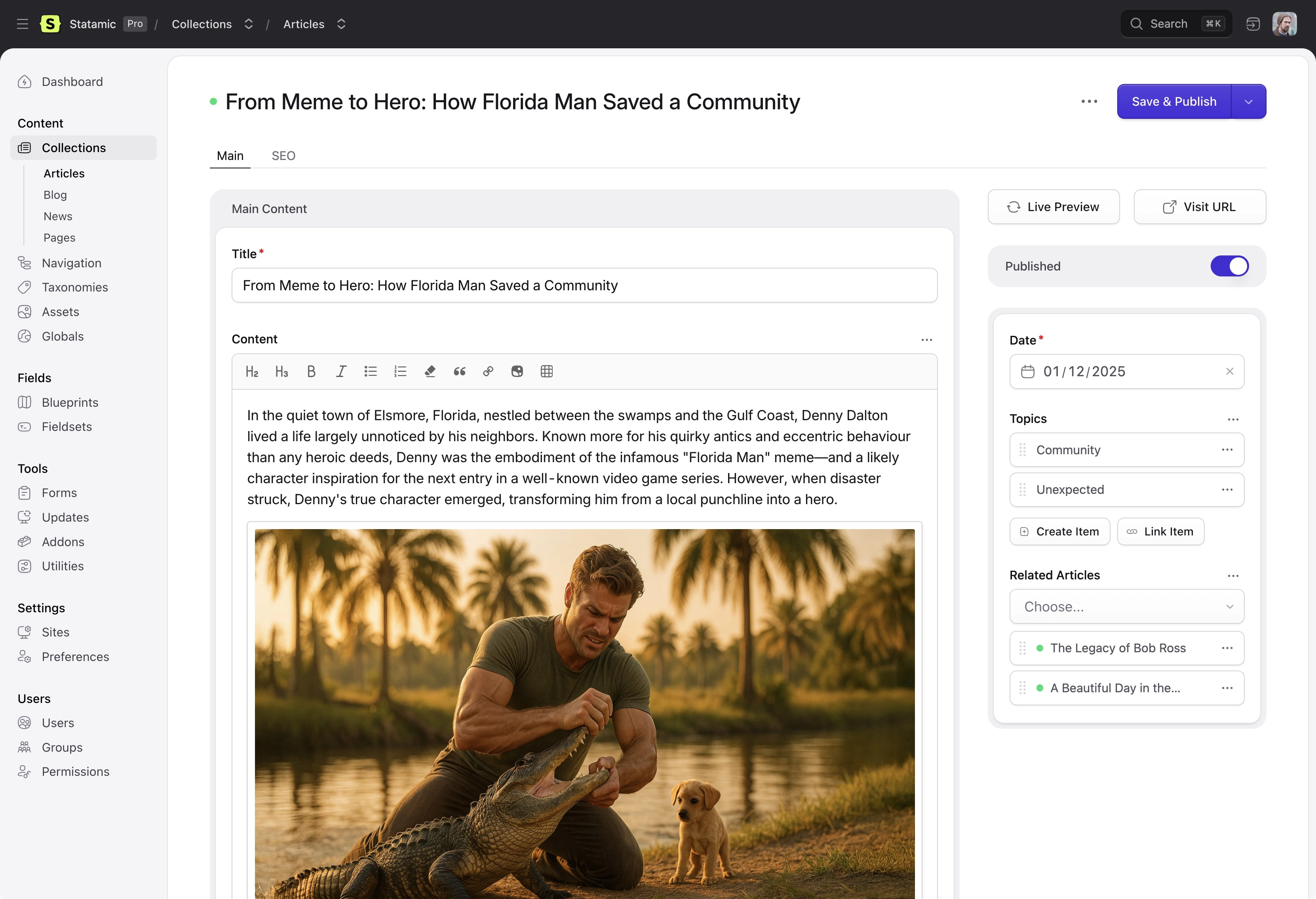
01 · Ecosystem fit
This is mostly an ecosystem decision.
Payload is built for TypeScript and Next.js teams. It’s excellent at what it does.
Statamic is built for Laravel and PHP teams. It installs as a Composer package into a standard Laravel application. All your existing knowledge — Eloquent, Blade, Artisan, queues, events, middleware — transfers directly.
The best CMS is usually the one that matches your team’s default tooling. If you ship Laravel apps all day, Statamic feels like home. If you live in the Node/TypeScript world, Payload is a strong choice.
02 · Flexible data
Choose your storage. Change it later.
Payload is database-backed (MongoDB or Postgres). That works great for many projects.
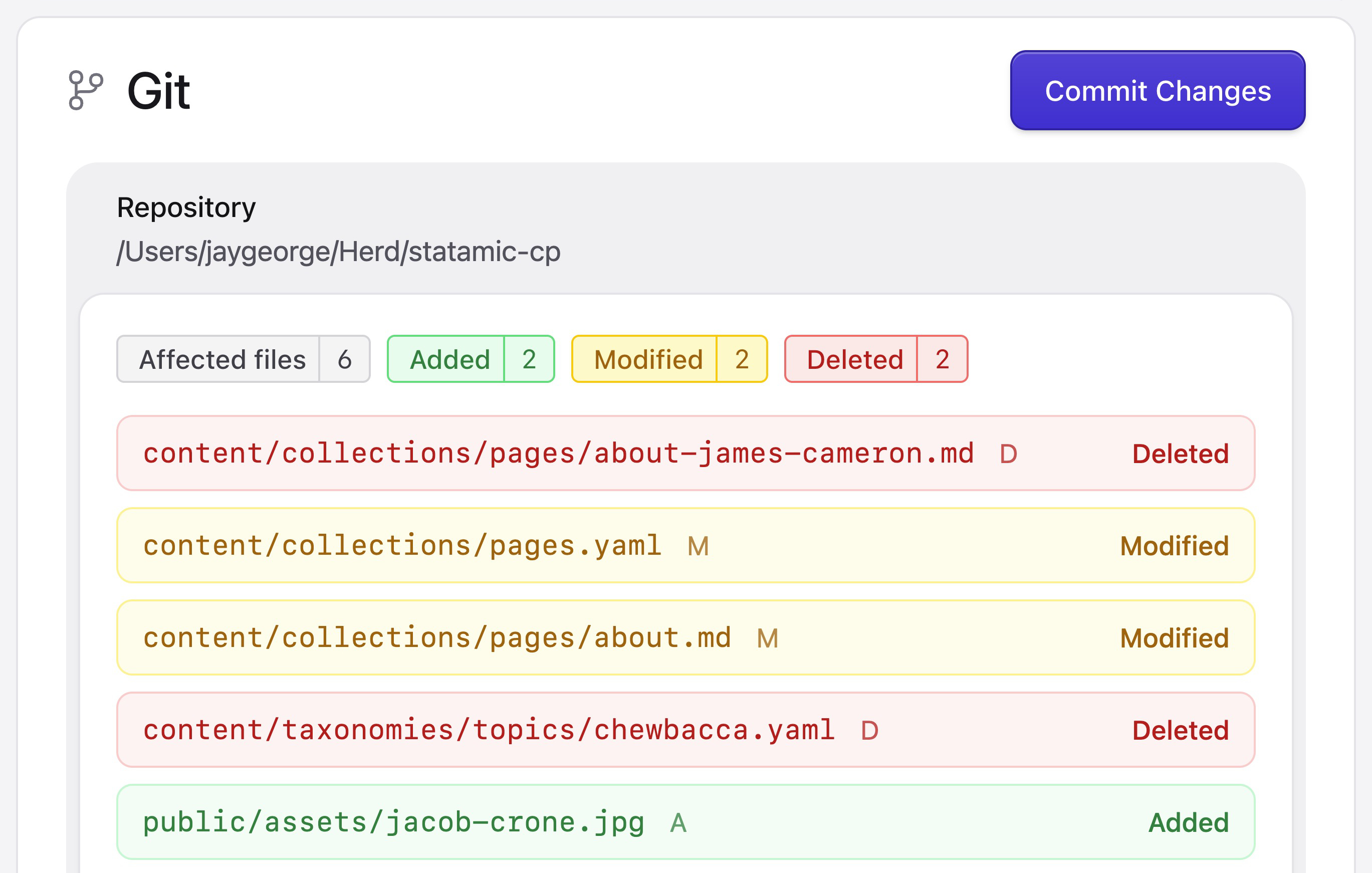
Statamic gives you more options:
- Flat files — content in Git, diffable edits, deploy with
git push - MySQL / Postgres — database-backed scale when you need it
- Hybrid — mix storage strategies per content type
Same templates, same blueprints, same CP. Switch strategies without reworking your project. No other CMS in either ecosystem offers content-in-Git as a first-class option.
03 · Out of the box
Batteries included. Even those quarter-sized ones.
Payload is powerful, but many projects require significant composition and custom development to cover common CMS needs.
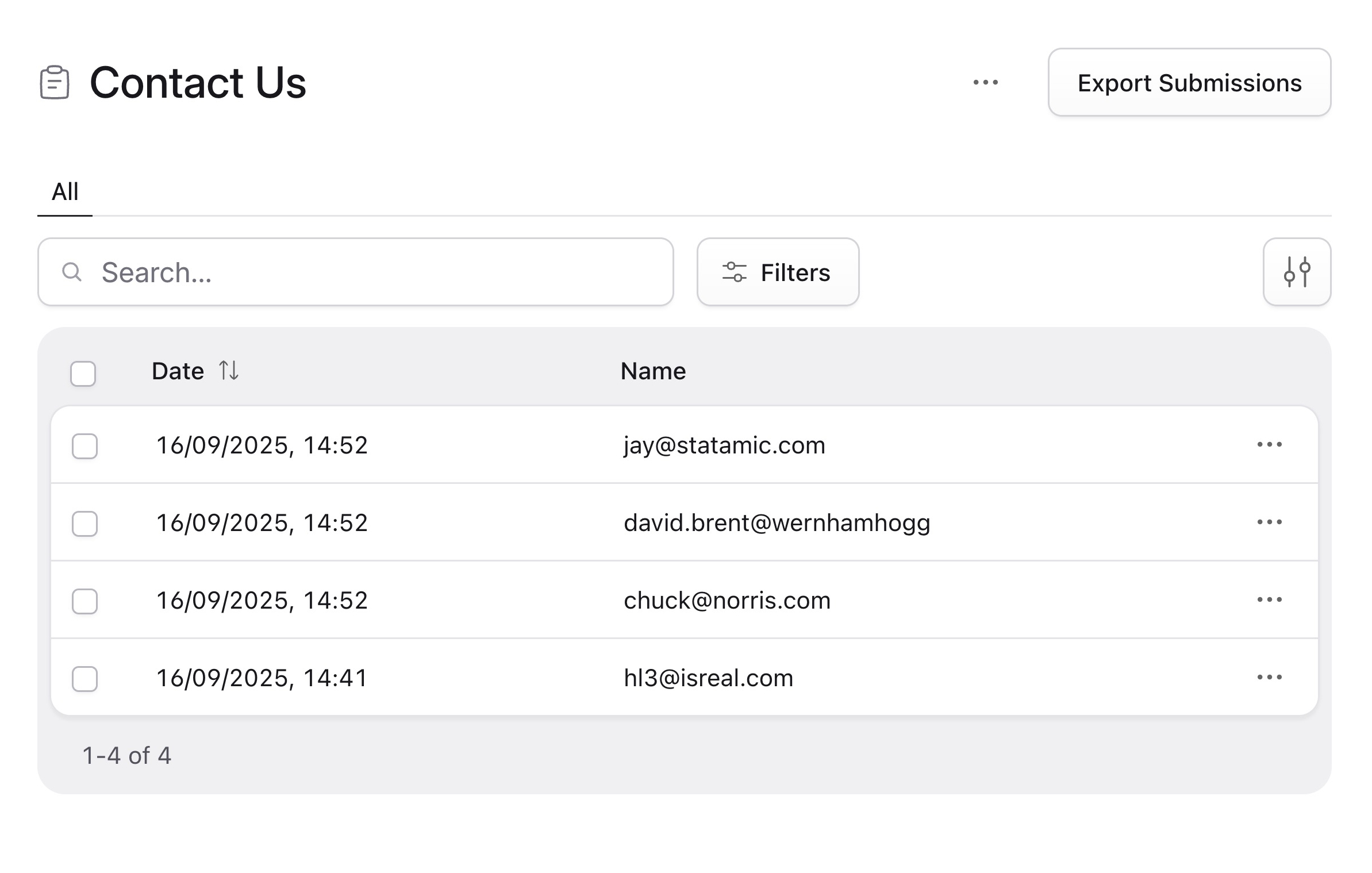
Statamic ships with a lot of practical functionality in core:
- Forms and submissions
- Search (local + Algolia)
- Navigation builder
- Static caching (half + full page)
- Image manipulation via Glide
- Auth with 2FA, Passkeys, and OAuth
- REST API and GraphQL
- Multi-site from one install
Less assembly means faster project delivery and fewer moving parts to maintain.
04 · Bard editor
Rich text editing that’s actually rich.
Payload’s Lexical-based editor is capable, but structured blocks live separately from text content.
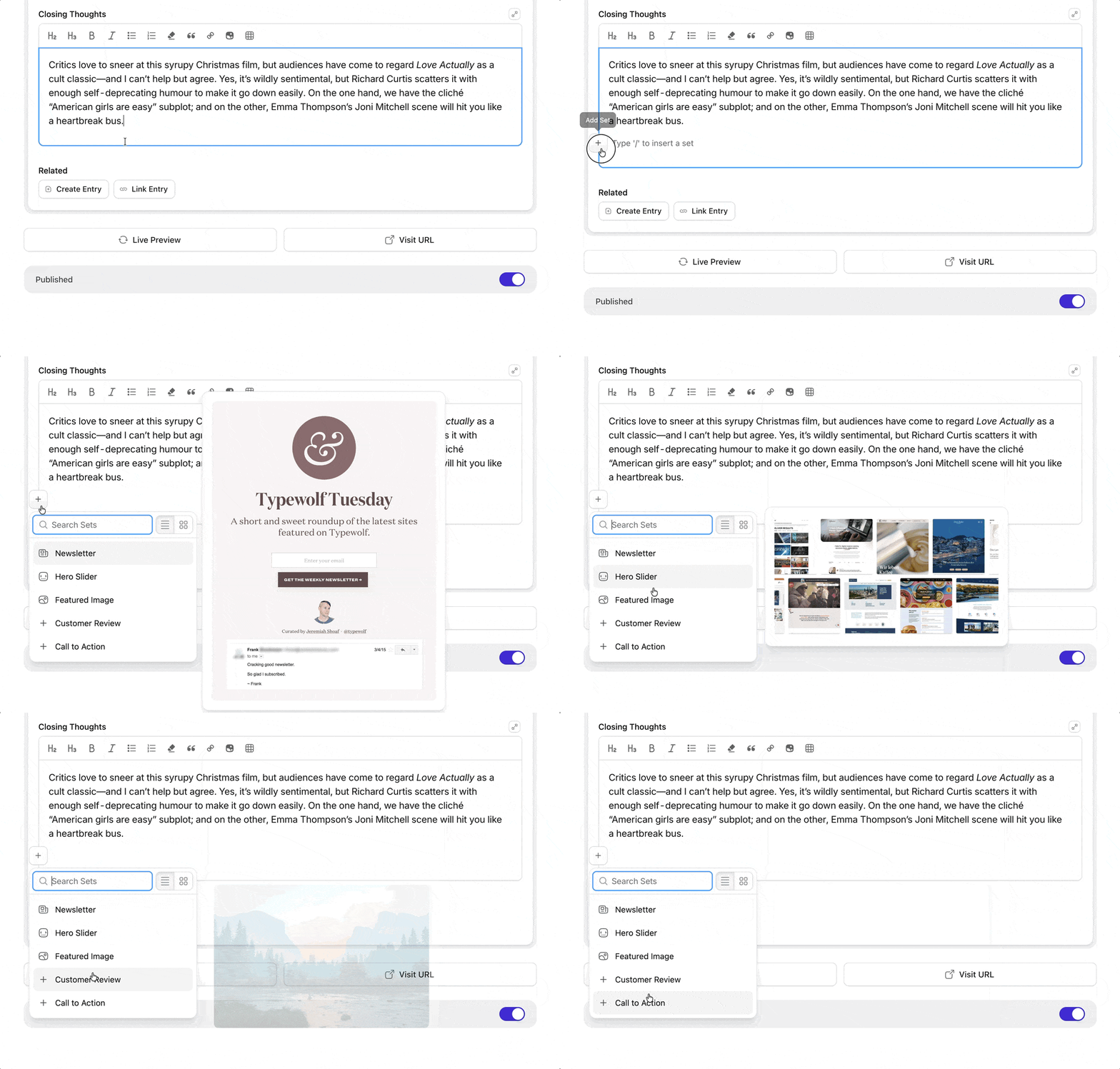
Statamic’s Bard editor lets you insert custom structured blocks inline within flowing rich text. Pull quotes, CTAs, image galleries, code snippets, custom components — all woven into the content flow, not stacked on top.
For editorial teams, documentation sites, and content-heavy marketing pages, this is a workflow difference you feel in minutes.
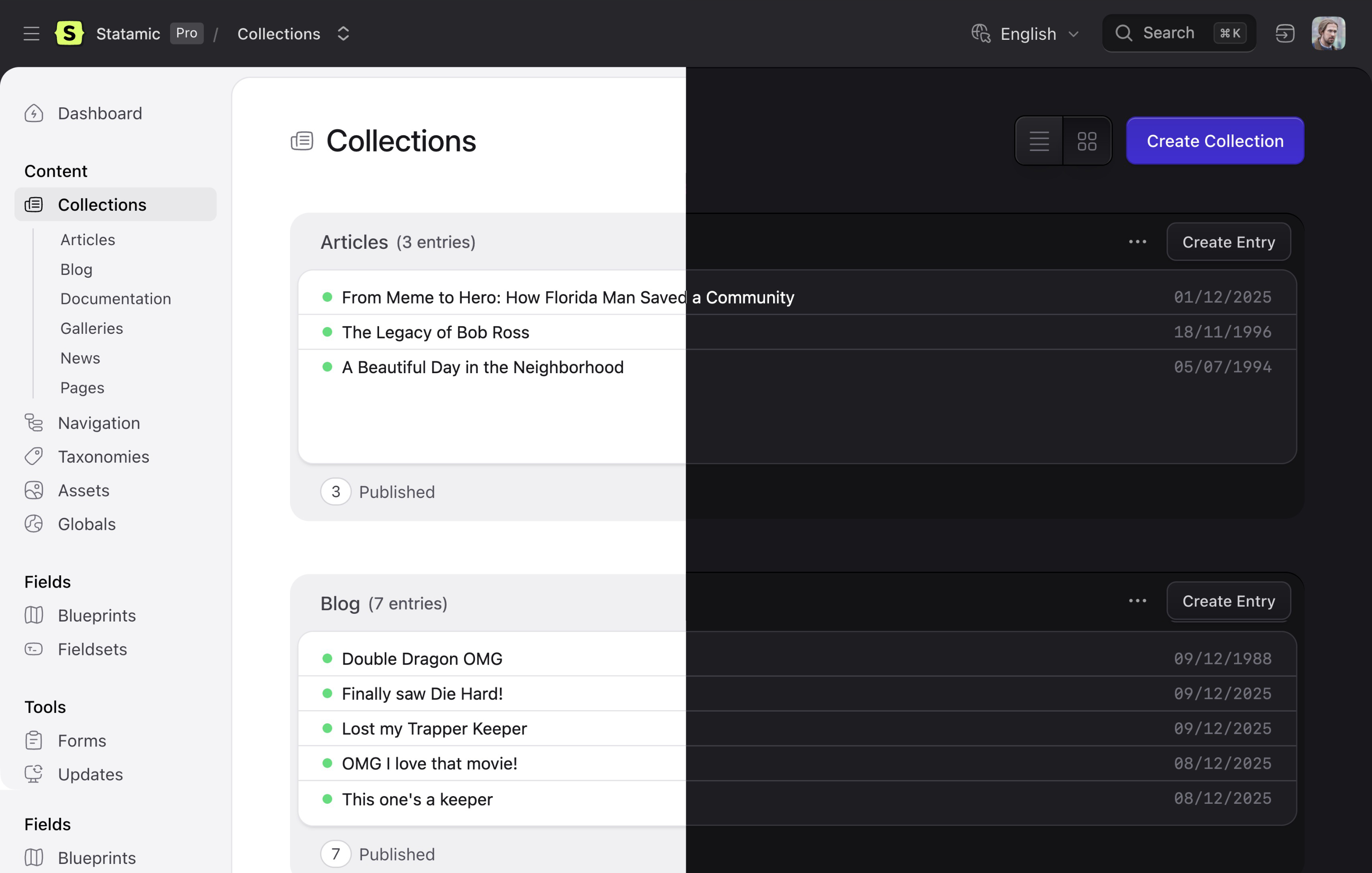
05 · Control panel
A control panel designed to spark joy.
Payload’s admin UI is modern and moving fast. Statamic 6 took the CP in a different direction — intentional design, not just functional tooling.
- Redesigned from scratch on Vue 3, Inertia, and Tailwind 4
- Dark mode with custom theme builder
- Command palette for keyboard-first workflows
- Live Preview with hot-reload and responsive testing
- Real-time multi-user collaboration
- Kitt — a shared UI component library for addon devs
Statamic has 12+ years of production use, a loyal agency community, and a track record of long-term support. Payload is newer and evolving rapidly — which is exciting, but means more change between versions.

Justin Jackson Founder, Transistor.fm
“The cool thing about buying from independent makers is your dollars get invested directly in their families.”

I’m a JavaScript developer. Can I use Statamic?
You can use Statamic as a headless CMS with REST or GraphQL and build your frontend in any JavaScript framework. The CMS itself runs on Laravel/PHP, but your frontend can be whatever you want.
Is Statamic open source?
Statamic Core is free and open source. Statamic Pro ($349 one-time) adds features like user roles & permissions, Git integration, the Content API, and GraphQL. Payload is MIT-licensed and fully free — that’s a real advantage if licensing cost is a primary concern.
Which handles larger-scale projects better?
Both scale well. Statamic’s driver-based architecture lets you start with flat files and move to MySQL/Postgres as content grows — same templates, zero rewrites. Payload is database-native from the start.
For very large datasets, both work; the right choice depends on your team’s ecosystem. For smaller sites, Statamic’s flat file approach is a real advantage. Avoid premature optimization everywhere you can and start shipping faster.
Where is Payload the better choice?
If your team is standardized on TypeScript/Next.js and wants an API-first, MIT-licensed CMS that lives in the JS ecosystem, Payload is a very reasonable choice. If your team is Laravel-first and wants a CMS with deep framework integration and strong editorial UX, Statamic is usually the better fit.