Ever heard of Squarespace through a podcast or YouTube ad?
01 · Own your site
Renting your apartment is fine. But your website you should actually own.
With Squarespace, your site lives entirely on their platform. The templates, the hosting, the content database, sometimes even the domain. It's all theirs. Leaving means rebuilding from scratch on a different stack.
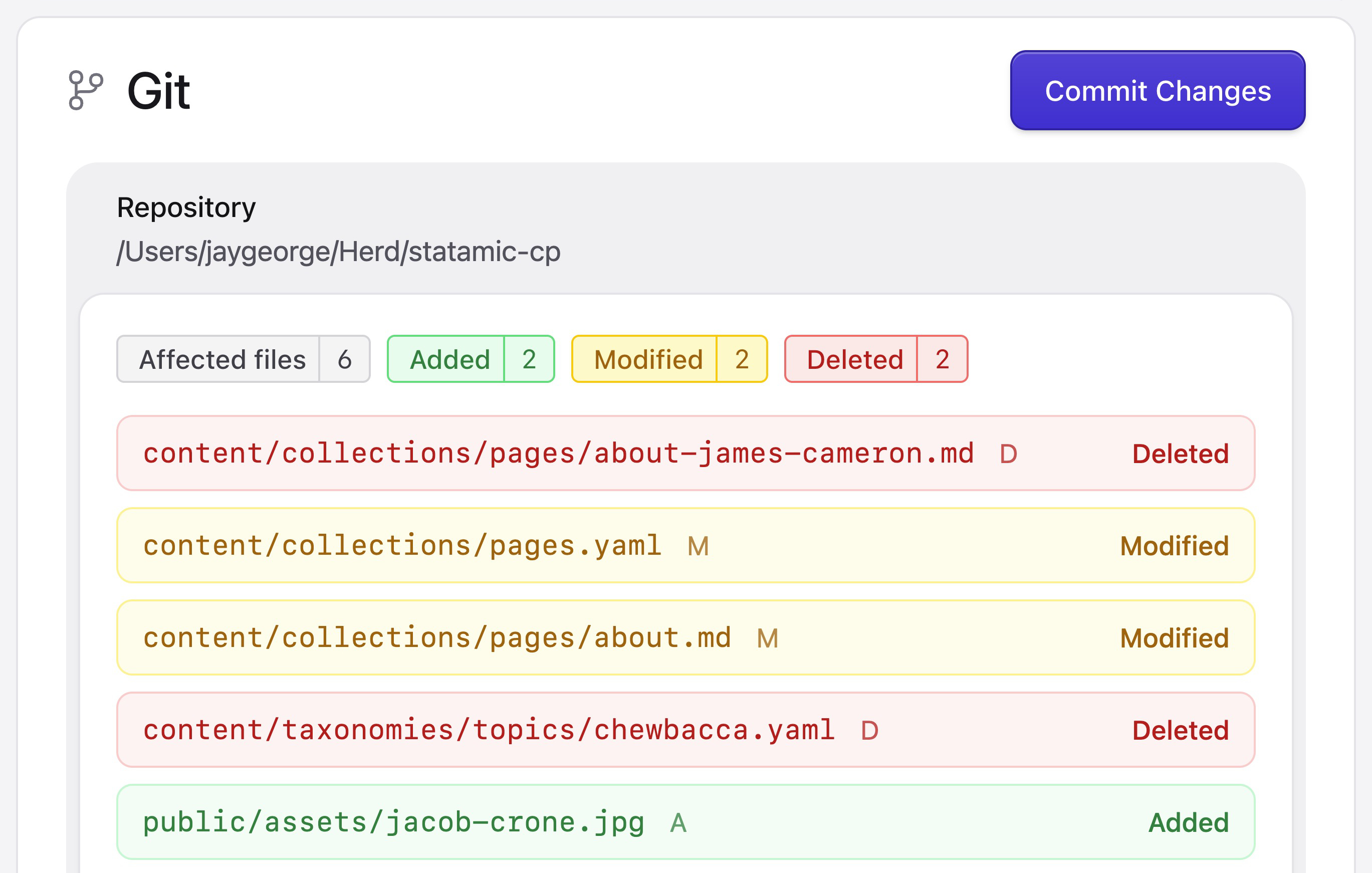
Statamic is yours, end to end:
- Source code you own
- Content in flat files or the database, your choice
- Hosting wherever you want
No platform deprecations, no template version migrations, no vendor acquisition surprises affecting your roadmap. The site you build today is the site you still own in the future.
02 · Pricing
$349 one time vs $20–$92/month, per site.
Squarespace plans start at $20/month (Basic) going up to $92/month (Advanced) per site, billed every month.
Statamic Pro is $349 one-time per site, with an optional $99/year renewal for updates and direct support.
For an agency running dozens of client sites on Squarespace, the cost can quickly explode and be thousands of dollars per year, every year. The cost of a Statamic license is predictable and hosting open to your requirements.
03 · Real content modeling
Structured content, not just pretty pages.
Squarespace is a templated website builder. Its content types are limited and standardized. Pages, Blogs, Products, Events, a few collection types. And you're composing pages within their limited block editor.
Statamic gives you a real CMS underneath:
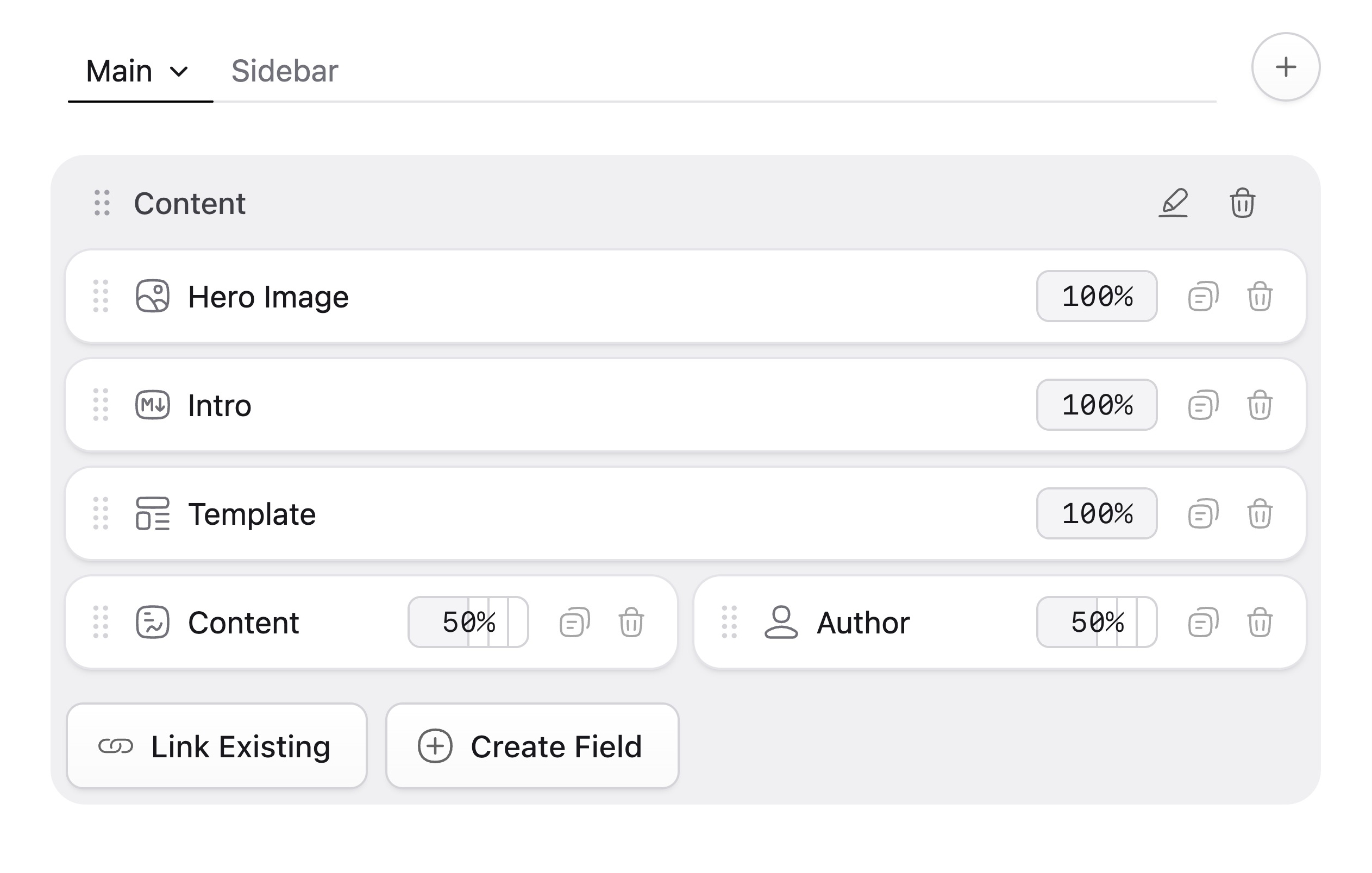
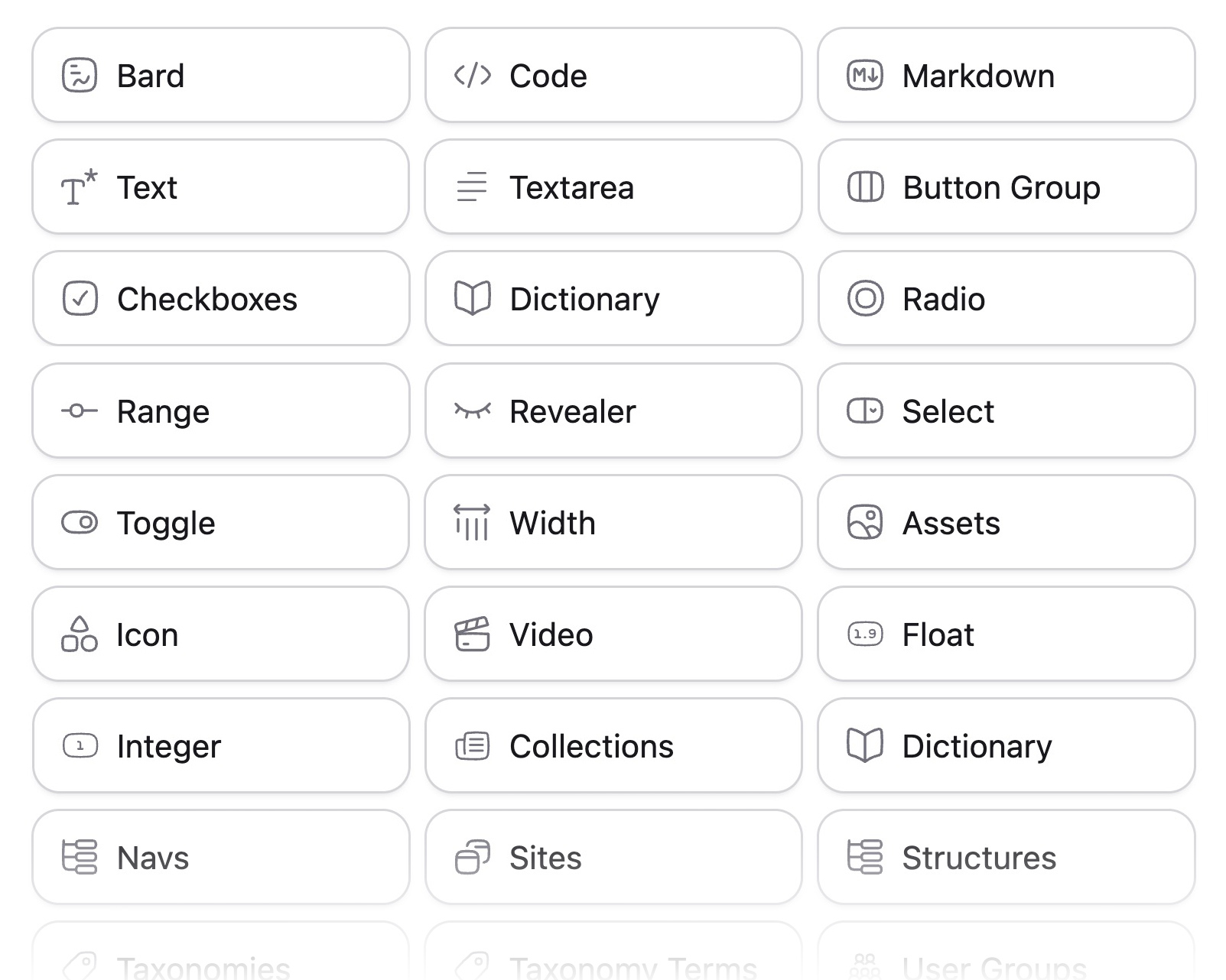
- Blueprints define exactly the fields each content type needs
- 65+ fieldtypes including Bard, Replicator, Grid, and assets
- Taxonomies, relationships, and globals for serious editorial structures
- Multi-site from one install serving localizations, regions, or even sub-brands
For sites with deep content like magazines, multi-language brands, complex product catalogs, or knowledge bases, the modeling difference is the whole ballgame.
04 · Developer power
A real codebase. A real framework. Endless possibilities.
Squarespace is a closed platform. You can drop in custom code blocks and tweak templates within their Developer Mode, but you're working inside the boundaries of what they allow you to do. Custom integrations, complex business logic, private APIs, and bespoke editorial workflows are all uphill battles.
Statamic is built on top of Laravel, one of the most popular frameworks available. You get Eloquent, Blade, Artisan, queues, events, middleware, broadcasting, testing, the entire framework. And three rendering modes from one install:
- Traditional — server-rendered with Antlers or Blade
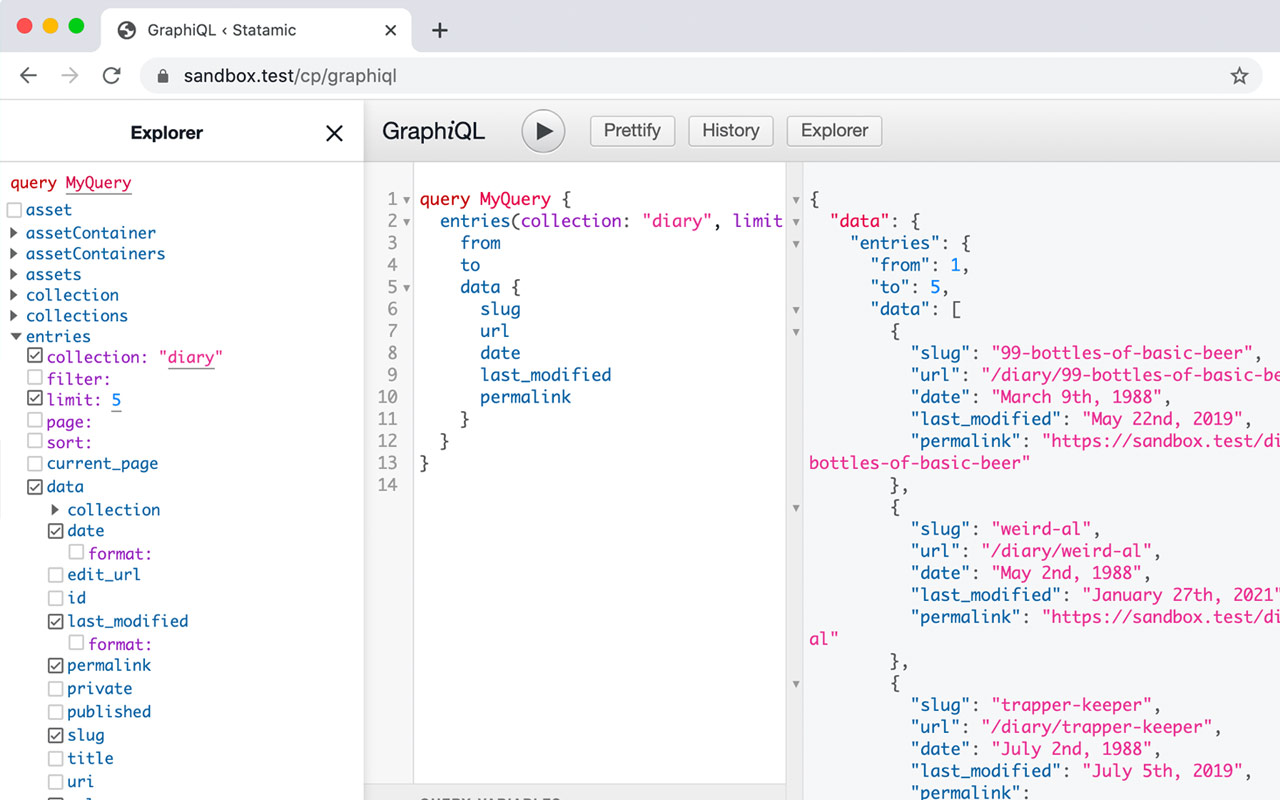
- Headless — REST API and GraphQL
- Hybrid — mix both in the same project
If your site might ever grow into something bigger than "a brochure with a blog," the foundation matters.
05 · Editorial experience
An editor experience your team will genuinely enjoy.
Squarespace's editor is approachable for one-person sites and small teams — that's a real strength. It gets thinner for editorial teams who need roles, workflows, structured content, and review processes.
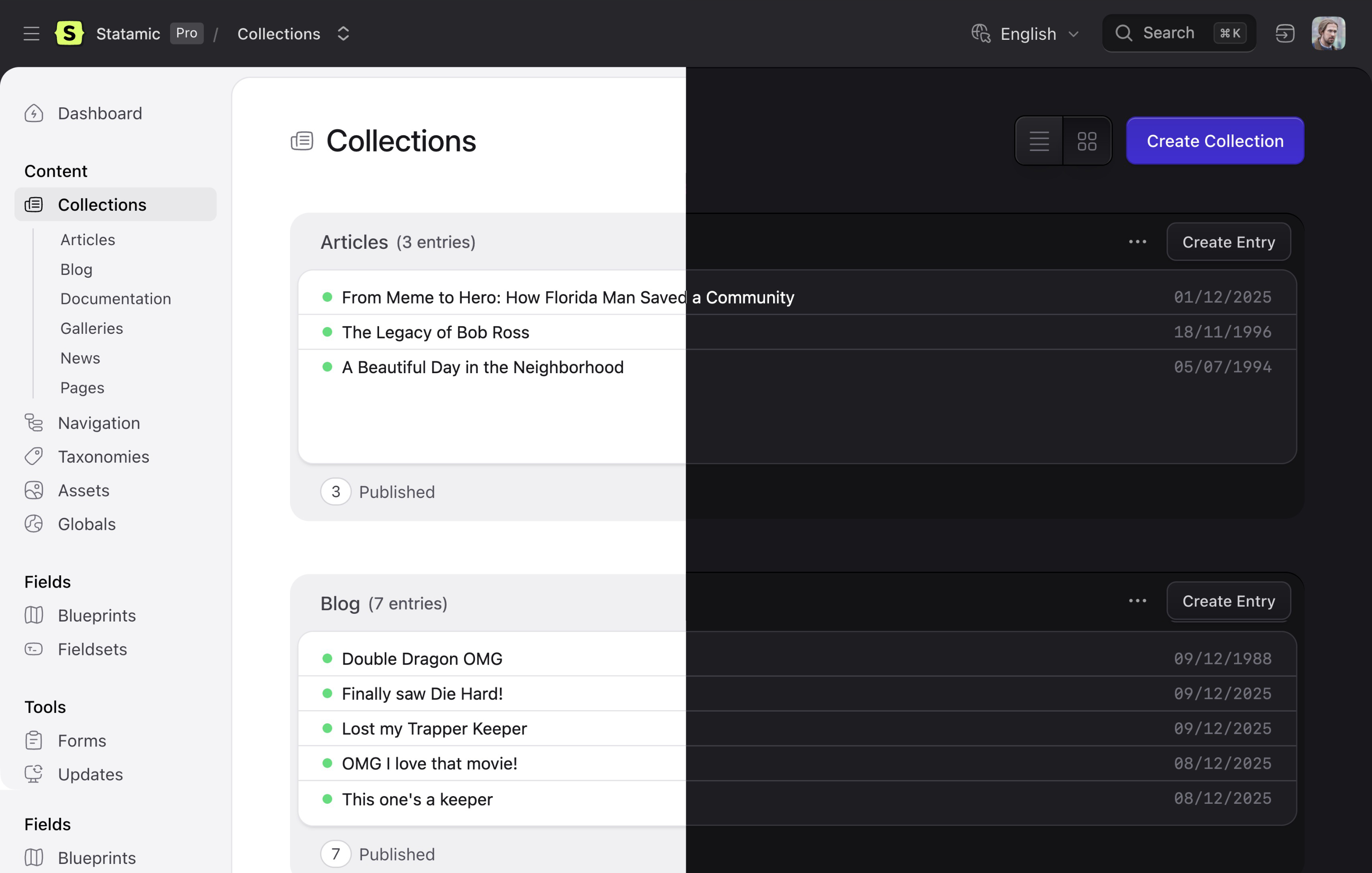
Statamic 6 ships a redesigned control panel built on Vue 3, Inertia, and Tailwind 4:
- Live Preview with hot-reload and responsive device testing
- Bard editor with structured blocks inline within rich text
- Dark mode, command palette, real-time collaboration with field locking
- Granular roles & permissions so editors only touch what they should
- Forms, search, navigation, static caching, image manipulation, 2FA, Passkeys, OAuth — all in core
Editors get a focused interface. Developers get freedom. Both get out of each other's way.

Sylvester Damgaard Principal Architect, TV2 Regionere
“Our journalists love Statamic! It scales perfectly as an enterprise CMS and significantly enhances our workflow.”

Squarespace has nice templates. Does Statamic?
Statamic is a CMS, not a templated builder. You (or a designer/developer) build the front-end with Antlers or Blade. That means the design is exactly what your project needs, not what fits a template family. There are some lovely starter kits available, but the real win is unlimited design freedom on a serious foundation.
Is self-hosting harder than letting Squarespace handle it?
Modern Laravel hosting platforms like Laravel Forge, Ploi, and many others make deploying and managing Statamic sites straightforward. If you can deploy a Laravel app, you can deploy Statamic — and you get full control over literally everything.
What about ecommerce?
Squarespace has built-in commerce and that’s a real advantage for simple stores. For Statamic, Cargo, Shopify, and other addons add ecommerce capabilities, integrating with Stripe and alike. For more complex shops, custom checkout flows, or B2B scenarios, both Statamic’s and Laravel’s flexibility tends to win over a simple solution like Squarespace.
Where is Squarespace the better choice?
If you’re a local shop, small business, or photographer who needs a polished site fast and never wants to think about hosting, code, or content modeling, Squarespace is a perfectly reasonable choice. If you need real content structure, ownership, predictable cost at scale, or any meaningful customization, Statamic is the better foundation.